
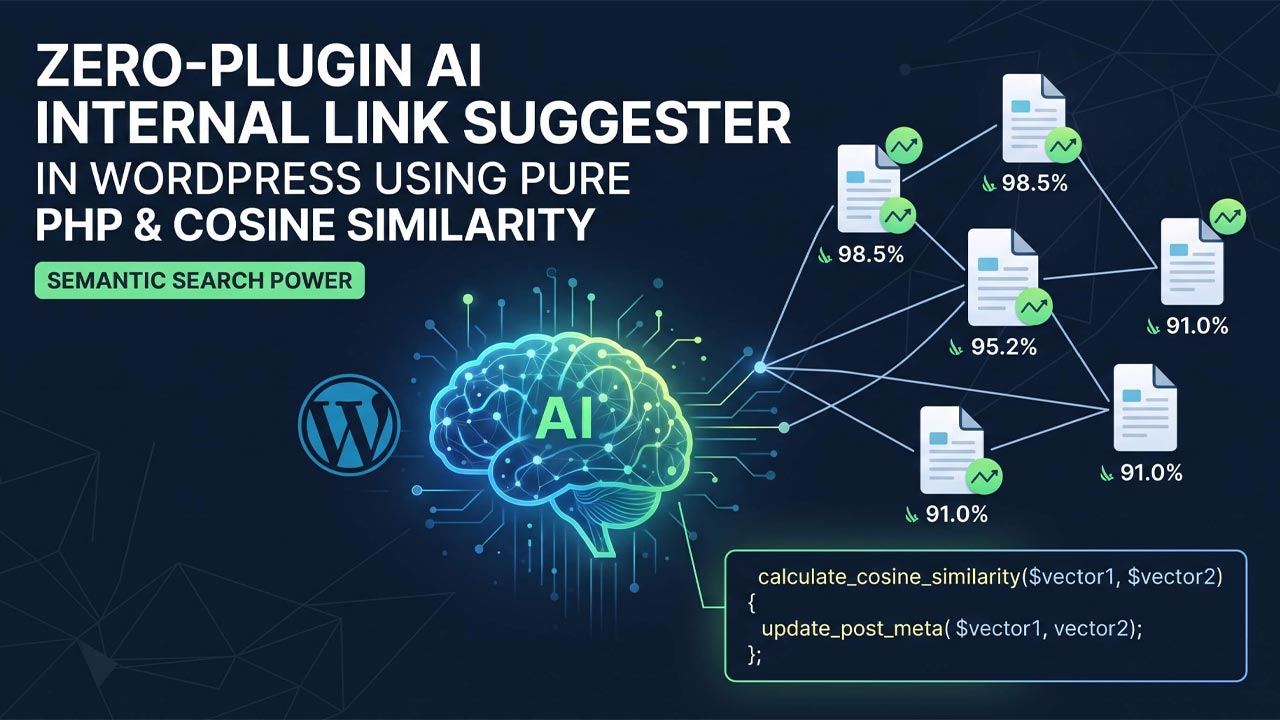
Zero-Plugin AI Internal Link Suggester in WordPress Using Pure PHP & Cosine Similarity
Keyword matching and shared tags miss plenty of relevant internal links because two articles can cover the same topic with different wording. A guide on database deadlocks and a tutorial on slow WooCommerce queries belong together in your internal link graph even when they share zero tags.
You can build a zero-plugin internal link suggester right inside your theme using WordPress’s built-in wp_remote_post() function, post meta storage, and pure PHP cosine similarity. No extra plugins, no external vector database, and no bloated runtime overhead.
Core Idea: Turn each post’s title, excerpt, and body into a compact embedding vector on save, store it in post meta, and rank candidate posts in pure PHP using cosine similarity.
| Layer | WordPress Primitive | Role in the Linker |
|---|---|---|
| Embeddings | wp_remote_post() + md5() hash | Generates vectors on publish/update only when content changes |
| Storage | update_post_meta() (512 dims) | Keeps vectors close to each post with low database footprint |
| Ranking | Pure PHP cosine similarity | Scores semantic closeness across published posts and skips existing links |
How Pure PHP Cosine Similarity Ranks Posts
Embeddings map text into a list of numbers where topically similar posts point in a similar direction. Cosine similarity measures the angle between two vectors on a scale from -1.0 to 1.0 by dividing their dot product by the product of their Euclidean magnitudes.
- Skip unchanged content: Hash the normalized title, excerpt, and trimmed body text so routine status or category tweaks do not trigger unnecessary API calls.
- Keep vectors compact: Requesting 512 dimensions trims serialized meta size and loop time while preserving strong semantic ranking.
- Filter out already-linked URLs: Check whether the candidate post’s permalink already appears in the current post content before surfacing it as a new opportunity.
Pure PHP Cosine Similarity & Suggestion Engine
Drop this class into your theme’s inc/ directory and load it from functions.php after defining your embedding API key in wp-config.php.
<?php
final class DNTH_AI_Internal_Linker {

	private const META_VECTOR = '_dnth_ai_embedding_vec';
	private const META_HASH   = '_dnth_ai_embedding_hash';
	private const DIMENSIONS  = 512;

	public static function init(): void {
		add_action( 'save_post_post', array( __CLASS__, 'maybe_generate_embedding' ), 20, 2 );
		add_action( 'add_meta_boxes', array( __CLASS__, 'register_metabox' ) );
	}

	public static function maybe_generate_embedding( int $post_id, WP_Post $post ): void {
		if ( defined( 'DOING_AUTOSAVE' ) && DOING_AUTOSAVE ) {
			return;
		}
		if ( wp_is_post_revision( $post_id ) || 'publish' !== $post->post_status ) {
			return;
		}

		$text = self::prepare_text( $post );
		if ( '' === $text ) {
			return;
		}

		$hash = md5( $text );
		if ( $hash === (string) get_post_meta( $post_id, self::META_HASH, true ) ) {
			return;
		}

		$vec = self::fetch_embedding( $text );
		if ( ! is_wp_error( $vec ) ) {
			update_post_meta( $post_id, self::META_VECTOR, $vec );
			update_post_meta( $post_id, self::META_HASH, $hash );
		}
	}

	private static function prepare_text( WP_Post $post ): string {
		$body = wp_trim_words( wp_strip_all_tags( strip_shortcodes( $post->post_content ) ), 600, '' );
		return trim( $post->post_title . "\n\n" . $post->post_excerpt . "\n\n" . $body );
	}

	private static function fetch_embedding( string $text ) {
		$key = defined( 'DNTH_OPENAI_API_KEY' ) ? DNTH_OPENAI_API_KEY : '';
		if ( '' === $key ) {
			return new WP_Error( 'dnth_no_key', 'Missing embedding API key.' );
		}

		$res = wp_remote_post(
			'https://api.openai.com/v1/embeddings',
			array(
				'timeout' => 15,
				'headers' => array(
					'Authorization' => 'Bearer ' . $key,
					'Content-Type'  => 'application/json',
				),
				'body'    => wp_json_encode(
					array(
						'model'      => 'text-embedding-3-small',
						'input'      => $text,
						'dimensions' => self::DIMENSIONS,
					)
				),
			)
		);

		if ( is_wp_error( $res ) || 200 !== wp_remote_retrieve_response_code( $res ) ) {
			return new WP_Error( 'dnth_embed_err', 'Embedding request failed.' );
		}

		$data = json_decode( wp_remote_retrieve_body( $res ), true );
		return ! empty( $data['data'][0]['embedding'] )
			? array_map( 'floatval', $data['data'][0]['embedding'] )
			: new WP_Error( 'dnth_embed_empty', 'Empty vector returned.' );
	}

	public static function cosine_similarity( array $a, array $b ): float {
		$len = count( $a );
		if ( 0 === $len || $len !== count( $b ) ) {
			return 0.0;
		}

		$dot = $mag_a = $mag_b = 0.0;
		for ( $i = 0; $i < $len; $i++ ) {
			$dot   += $a[ $i ] * $b[ $i ];
			$mag_a += $a[ $i ] * $a[ $i ];
			$mag_b += $b[ $i ] * $b[ $i ];
		}

		$denom = sqrt( $mag_a ) * sqrt( $mag_b );
		return $denom > 0.0 ? ( $dot / $denom ) : 0.0;
	}

	public static function get_suggestions( int $post_id, int $limit = 5, float $min_score = 0.45 ): array {
		$post       = get_post( $post_id );
		$source_vec = get_post_meta( $post_id, self::META_VECTOR, true );
		if ( ! $post || ! is_array( $source_vec ) ) {
			return array();
		}

		global $wpdb;
		$rows = $wpdb->get_results(
			$wpdb->prepare(
				"SELECT p.ID, p.post_title, pm.meta_value
				 FROM {$wpdb->posts} p
				 INNER JOIN {$wpdb->postmeta} pm ON p.ID = pm.post_id
				 WHERE p.post_type = 'post' AND p.post_status = 'publish'
				   AND p.ID != %d AND pm.meta_key = %s",
				$post_id,
				self::META_VECTOR
			)
		);

		$matches = array();
		foreach ( $rows as $row ) {
			$target_vec = maybe_unserialize( $row->meta_value );
			if ( ! is_array( $target_vec ) ) {
				continue;
			}
			$score = self::cosine_similarity( $source_vec, $target_vec );
			if ( $score >= $min_score ) {
				$url       = get_permalink( (int) $row->ID );
				$matches[] = array(
					'title'          => $row->post_title,
					'url'            => $url,
					'score'          => round( $score * 100, 1 ),
					'already_linked' => false !== strpos( $post->post_content, $url ),
				);
			}
		}

		usort( $matches, static fn( $x, $y ) => $y['score'] <=> $x['score'] );
		return array_slice( $matches, 0, $limit );
	}

	public static function register_metabox(): void {
		add_meta_box( 'dnth-ai-links', 'AI Internal Link Suggestions', array( __CLASS__, 'render_metabox' ), 'post', 'side' );
	}

	public static function render_metabox( WP_Post $post ): void {
		$items = self::get_suggestions( $post->ID );
		if ( ! $items ) {
			echo '<p>Save a published post once other embedded posts exist to see matches.</p>';
			return;
		}
		foreach ( $items as $item ) {
			$badge = $item['already_linked'] ? ' (Already linked)' : '';
			printf(
				'<p><strong>%s%%</strong>%s<br><a href="%s" target="_blank" rel="noopener">%s</a></p>',
				esc_html( $item['score'] ),
				esc_html( $badge ),
				esc_url( $item['url'] ),
				esc_html( $item['title'] )
			);
		}
	}
}
DNTH_AI_Internal_Linker::init();
Scaling & Editorial Workflow Tips
- Tune your similarity threshold: Start around
0.45and raise or lower it based on how tightly focused your blog categories are. - Backfill older posts in batches: Run a small CLI or admin batch script over existing published posts so new articles can immediately compare against your archive.
- Keep links natural: Use semantic similarity to find the right target article, then write descriptive anchor text inside a relevant paragraph rather than stuffing link lists.
Quick FAQ
Does this require a vector database plugin or Node build step?
No. It runs purely in PHP using standard WordPress post meta and HTTP requests, making it easy to maintain inside a custom theme.
Will saving a draft or updating a category burn API credits?
No. The hook skips autosaves and non-published statuses, and compares an md5() content hash before calling the embeddings endpoint.